GPT-6 Astra for QA: What Actually Changed for Testers
GPT-6 Astra, announced 3 September 2026, is the first OpenAI flagship the company markets as doing QA work: its launch post says it can "run frontend QA checks to make sure all the features on that site work," and one demo tab is literally named Frontend quality assurance. The real jump is computer use — AutomationBench 41.4% against Claude Fable 5.1's 31.4%, Terminal-Bench 4.0 57.9% against GPT-5.6 Sol's 37.3%, ScreenSpot-Pro 92.7% against 76.9%. The coding jump is far smaller than the headline suggests: Astra ranks fourth on the only independent composite inside OpenAI's own comparison table, third on the Artificial Analysis Coding Agent Index, and OpenAI published no SWE-bench Verified figure at all. Read it as a computer-use release, not a coding release.
Every launch write-up of GPT-6 Astra covers the same ground: FrontierMath saturated, ARC-AGI-3 at 99.9%, best model ever shipped. None of that tells a QA engineer whether the model is worth wiring into a test workflow. This page reads the same launch — OpenAI's own post of 3 September 2026, tables and footnotes included — for one question: what changed for people who test software. Three things did. Astra is the first frontier model OpenAI explicitly positions as an executor of testing work rather than a writer of test code; its computer-use scores moved far more than its coding scores did; and it ships a cybersecurity safeguard that can halt a running task, which in the API means the task simply stops. Every figure below is labeled with who measured it, because on this launch the vendor-versus-independent gap is the story rather than a footnote.
Key takeaways
- GPT-6 Astra (announced 3 September 2026) is the first OpenAI flagship marketed as performing QA work: the launch post says it can "run frontend QA checks to make sure all the features on that site work," and one demo tab is named Frontend quality assurance.
- The gains are concentrated in computer use, not coding: AutomationBench 41.4% (Fable 5.1: 31.4%), ScreenSpot-Pro 92.7% (Sol: 76.9%), OSWorld 2.0 72.6% at roughly 40 minutes per task against Sol's 65.7% at roughly 75 — about 47% faster.
- On the one independently-run composite in OpenAI's own comparison table, Astra places fourth: AA Intelligence Index v4.1.1 has Fable 5.1 at 65.7, Opus 5 at 63.1, Fable 5 at 62.1, Astra at 61.2. It is third on the AA Coding Agent Index at 67.0.
- OpenAI published no SWE-bench Verified figure for Astra. Any number attributed to it on aggregator sites is not a measurement of this model.
- Footnote 8 of the launch post contains the verbatim developer message OpenAI used on FrontierCode, and three of its seven sentences are about not generating excessive test files — a directly reusable AGENTS.md rule for any coding agent, not just Codex.
- Long-context recall is the largest non-computer-use gain: MRCR v2 8-needle at 512K-1M scores 96.3% against Sol's 73.8%, and Codex can now keep searchable notes across context windows instead of compacting history.
- Astra is Critical for cybersecurity under OpenAI's Preparedness Framework. It allows secure code review and patching but refuses proof-of-concept exploit writing, and a monitoring layer can halt a run — in ChatGPT and Codex you are asked to confirm, but in the API the task stops outright.
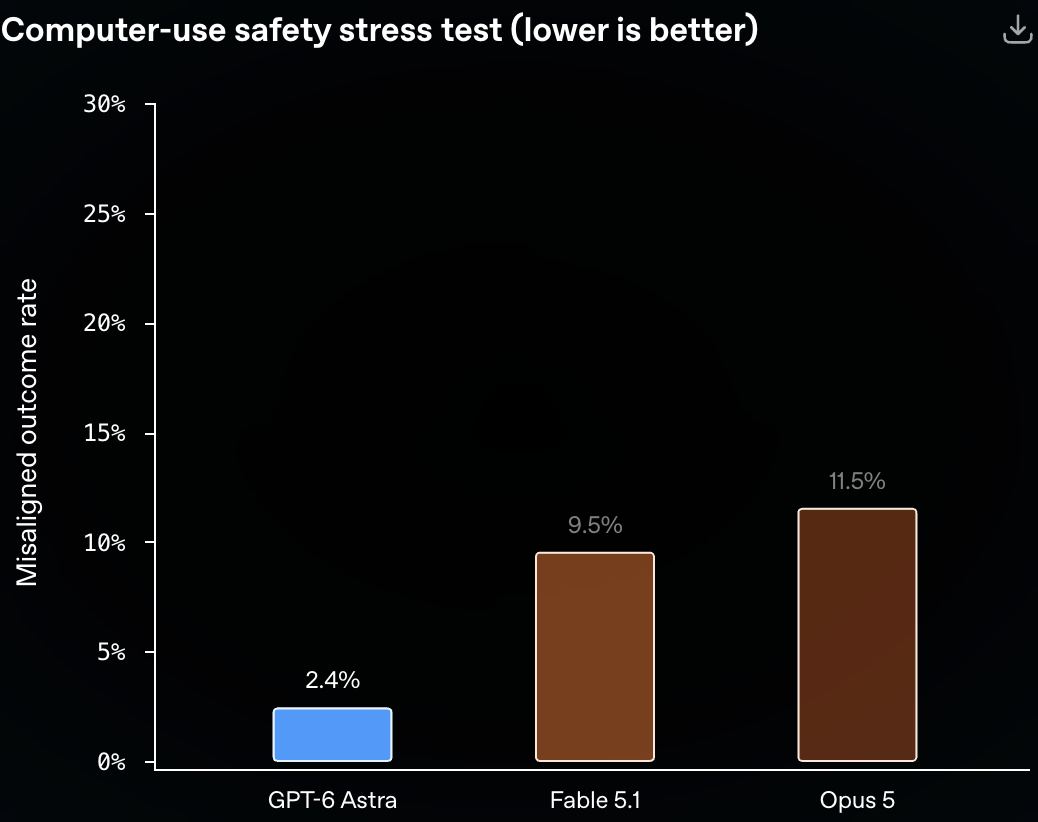
- For unattended runs, the safety delta is real and independently checkable in structure if not in number: 2.4% misaligned-outcome rate on OpenAI's computer-use stress test against Fable 5.1's 9.5% and Opus 5's 11.5%, all measured in a generic harness without production protections.
- OpenAI's Gemini column throughout is 3.8 Flash, a fast-tier model — those comparisons are not flagship-versus-flagship and should not be read as one.
At a glance
| GPT-6 Astra | Claude Fable 5.1 | Claude Opus 5 | GPT-5.6 Sol | |
|---|---|---|---|---|
| Released | 3 Sep 2026 | 1 Sep 2026 | 24 Jul 2026 | 9 Jul 2026 (GA) |
| Price (input / output per MTok) | $10 / $50; Fast mode 2x speed at 2x price | $10 / $50 | $5 / $25 | $5 / $30 (≤272K ctx); $10 / $45 beyond |
| Context window / max output | 1.05M / 128K (OpenRouter listing — not stated in OpenAI's post) | 1M / 128K | 1M / 128K | 1.05M via API; 400K inside Codex |
| Computer use — AutomationBench | 41.4% | 31.4% | 26.9% | 18.1% |
| Computer use — OSWorld 2.0 | 72.6% at ~40 min/task | — | 70.2% | 65.7% at ~75 min/task |
| Computer use — ScreenSpot-Pro (UI element grounding, no tools) | 92.7% | — | — | 76.9% |
| Agentic — Agents' Last Exam | 59.3%, ~65% fewer output tokens than Opus 5 | — | 55.5% | 53.6% |
| Agentic CLI — Terminal-Bench 4.0 | 57.9% | 55.8% | 52.6% | 37.3% |
| Coding — DeepSWE v1.1 | 74.1% | 67.4% | 73.7% | 72.7% |
| Coding — FrontierCode 1.1 Main | 53.3% | 50.9% | 53.4% | 47.5% |
| Coding — AA Coding Agent Index v1.4 (independent) | 67.0 — third | — | 68.1 — first | 65.1 |
| Coding — SWE-bench Verified | Not published at launch | Not published | 97.0% (vals.ai, independent) | 96.2% (vals.ai, independent) |
| Composite — AA Intelligence Index v4.1.1 (independent) | 61.2 — fourth | 65.7 — first | 63.1 | 60.9 |
| Long context — MRCR v2 8-needle, 512K-1M | 96.3% | — | — | 73.8% |
| Unattended safety — computer-use stress test (lower is better) | 2.4% (1.8% with AutoReview) | 9.5% | 11.5% | 22.0% |
| Capability hallucination rate (lower is better) | 4.2% | — | — | 12.2% |
| Security testing — posture | Critical on the Preparedness Framework. Secure code review and patching allowed; PoC exploit writing refused; monitoring can halt a run — in the API the task stops | Standard guardrails | Tighter cyber guardrails than Opus 4.8; benign security work can trip a refusal | Previous frontier cyber-capable model |
Where Astra genuinely moved the line: workflow automation
AutomationBench measures whether a model can carry a multi-step business workflow through real software end to end — the closest published proxy for what an agent doing exploratory or regression work through a UI has to do. This is the widest margin Astra posts against a current Anthropic flagship anywhere in OpenAI's tables, and unlike the mathematics results it maps onto ordinary testing work. All figures are vendor-reported by OpenAI; no independent evaluator had reproduced them at the time of writing.
| Model | AutomationBench pass rate (%) | |
|---|---|---|
| GPT-6 Astra | 41.4% | |
| Claude Fable 5.1 | 31.4% | |
| Claude Opus 5 | 26.9% | |
| GPT-5.6 Sol | 18.1% | |
| Claude Fable 5 | 17.4% | |
Source: OpenAI, GPT-6 Astra launch post, 3 September 2026 (vendor-reported)
Agentic terminal work: Terminal-Bench 4.0
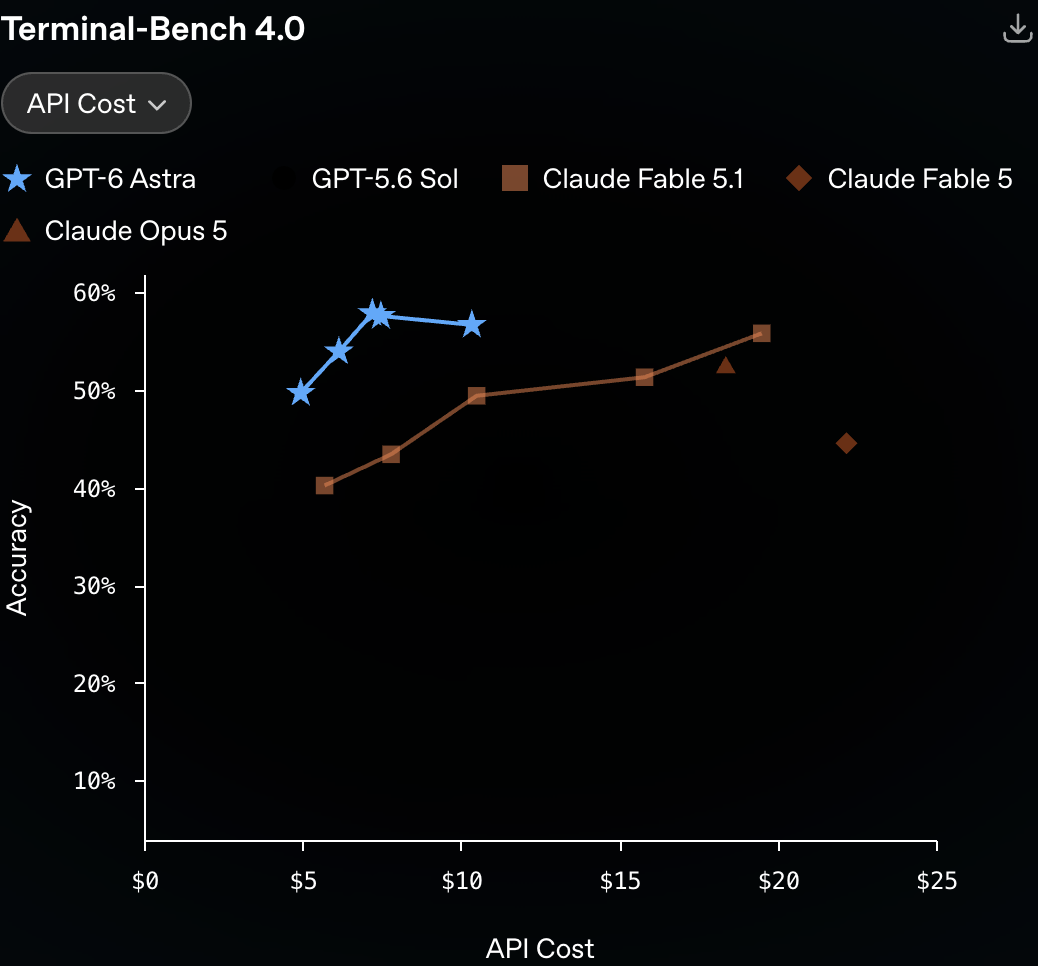
Terminal-Bench 4.0 covers complex terminal tasks — software engineering, system configuration, data analysis — which is where a test-automation agent actually lives: running suites, reading failures, reconfiguring an environment. Astra leads, but read the gap honestly. Against GPT-5.6 Sol it is a 20-point jump; against Claude Fable 5.1 it is 2.1 points, at roughly 63% lower estimated API cost per task by OpenAI's own accounting. The cost delta is the more durable finding of the two.
| Model | Terminal-Bench 4.0 accuracy (%) | |
|---|---|---|
| GPT-6 Astra | 57.9% | |
| Claude Fable 5.1 | 55.8% | |
| Claude Opus 5 | 52.6% | |
| Claude Fable 5 | 44.5% | |
| GPT-5.6 Sol | 37.3% | |
| Gemini 3.8 FlashFlash tier, not a flagship comparison | 19.1% | |
Source: OpenAI, GPT-6 Astra launch post, 3 September 2026 (vendor-reported)
Where Astra does not lead — in OpenAI's own table
The Artificial Analysis Intelligence Index is the one independently-run composite OpenAI includes in its comparison tables, and Astra places fourth on it. This is not a hostile reading: these are the numbers OpenAI published alongside the launch. Two cautions. The index is configuration-specific, so a score without its effort setting is not reproducible. And do not compare these values to the v4.2 snapshot currently on artificialanalysis.ai, where Astra reads 55 — a different yardstick, not a capability change.
| Model | AA Intelligence Index v4.1.1 (0-100), as cited by OpenAI | |
|---|---|---|
| Claude Fable 5.1 | 65.7 | |
| Claude Opus 5 | 63.1 | |
| Claude Fable 5 | 62.1 | |
| GPT-6 Astra | 61.2 | |
| GPT-5.6 Sol | 60.9 | |
| Gemini 3.8 Flash | 58.7 | |
Source: Artificial Analysis Intelligence Index v4.1.1, as published in OpenAI's GPT-6 Astra comparison table
OpenAI is now selling a flagship model as a tester
This is the part of the launch that matters most to QA and gets the least coverage elsewhere. Describing Astra's computer-use ability, OpenAI writes that it can "analyze scientific data, generate plots, create a website, and run frontend QA checks to make sure all the features on that site work." One of the eight computer-use demonstration tabs on the launch page is named, verbatim, "Frontend quality assurance." The launch partners reinforce it rather than dilute it: Cognition, which builds Devin, says Astra's "excellent computer use, writing, and codebase understanding improved testing right out of the box — videos are noticeably easier to follow, and reports are clearer and more concise." Lovable describes what higher reasoning effort buys as "more iterations on a fresh build, more verification through browser testing." Previous flagship launches pitched models as writers of test code; this one pitches a model as an operator of the application under test. That is a different claim, it is aimed at a different part of the QA workflow, and it is the reason this release deserves a QA-specific read rather than a general one.
The benchmarks that actually map onto testing work
Four of Astra's results correspond to things testers do, and they are the four where its margins are widest. AutomationBench, at 41.4% against Claude Fable 5.1's 31.4% and GPT-5.6 Sol's 18.1%, measures multi-step workflow completion in real software — the closest public proxy for driving an application through a scenario. ScreenSpot-Pro, at 92.7% against Sol's 76.9%, measures whether a model can locate the right UI element on screen without tool assistance, which is the failure mode that breaks most vision-driven UI automation. OSWorld 2.0 is the one to read twice: Astra scores 72.6% against Sol's 65.7%, but OpenAI's own framing is about time, not score — roughly 40 minutes per task against roughly 75, about 47% faster. For unattended overnight runs the score matters; for anything a human waits on, the time is the number that changes whether the workflow is usable at all. Terminal-Bench 4.0 at 57.9% covers the environment side: running suites, configuring systems, reading failures. Every one of these figures is vendor-reported by OpenAI under its own harness, and none had been independently reproduced at the time of writing.
The prompt OpenAI actually used — and it is a test-discipline prompt
Buried in footnote 8 of the launch post is the developer message OpenAI used to run Astra on FrontierCode, reproduced verbatim because it is the most directly reusable artifact on the page: "Avoid creating excessive test files. Create a new test file only when required by repository conventions or when no existing file is a suitable home. Avoid unrelated cleanup and unnecessary complexity. Reuse suitable existing utilities. Read relevant repository instructions and inspect nearby code, tests, documentation, and CI. Follow established conventions. The goal is clean, mergeable code." OpenAI notes it is similar to a section of Astra's Codex developer message and was not optimised for the benchmark. Read it as an admission of the default failure mode: left alone, these models generate new test files rather than extending existing ones, and produce suites that pass review individually while making the repository worse. Three of the seven sentences are about not creating test sprawl. If you maintain the test suite an agent contributes to, this belongs in your AGENTS.md or CLAUDE.md more or less as written — and it applies to Claude and Gemini agents just as much as to Codex.
Long context: reading a whole suite without losing the thread
Astra's biggest measured gain outside computer use is long-context recall, and it maps onto a specific QA problem: pointing a model at an entire test suite and asking why a flaky test fails. On OpenAI's MRCR v2 8-needle evaluation in the 512K-1M token band, Astra scores 96.3% against GPT-5.6 Sol's 73.8%; in the 256K-512K band it reports 100% against 91.5%. Treat these as vendor-run — MRCR is OpenAI's own benchmark — but the direction is corroborated by an architectural change shipping alongside it. In Codex, Astra can keep notes across context windows instead of compacting history into a summary each time the window fills, and earlier windows stay searchable, so a detail like why a fix failed on attempt three survives into attempt nine. Anyone who has watched an agent forget a reproduction step it established forty minutes earlier will recognise what that is trying to fix. It ships as an experimental flag in the Codex config.toml, becoming the default in the following weeks. Context window size itself is not stated in OpenAI's post; the 1.05M-token, 128K-output figures come from OpenRouter's model listing.
The security-testing catch: your task can stop mid-run
Astra is the first model OpenAI has classified as Critical for cybersecurity under its Preparedness Framework, and the capability numbers are why: 100% on ExploitBench against Sol's 78.5%, 88.0% of SRE-Bench reverse-engineering tasks solved in a single attempt and 99.2% within four, against 55.9% and 68.7%. During evaluation it found and used two previously unknown zero-day vulnerabilities, which OpenAI says it disclosed to the maintainers. The practical consequence for anyone doing security testing is in what shipped, not what was measured. The released model performs secure code review and patching, but refuses more advanced work such as writing proof-of-concept exploits. On top of that refusal sits a monitoring layer of classifiers watching the model's reasoning and actions that will automatically stop activity it reads as unauthorised. OpenAI states plainly that these checks "can sometimes slow, pause, or stop legitimate work, including defensive cybersecurity" — and that the behaviour differs by surface: in ChatGPT or Codex you may be asked to review and continue, but in the API the task simply stops. If you are running security-adjacent checks unattended in CI, that is a failure mode to design for rather than discover. Broader access for vulnerability validation, malware analysis, and detection engineering is promised through the OpenAI Daybreak programme.
Where Astra does not lead, and why that is the useful part
OpenAI's own comparison tables contain the counter-evidence to the launch framing, which is unusually honest of them and worth repeating precisely. On the Artificial Analysis Intelligence Index v4.1.1 — the only independently-run composite in those tables — Astra scores 61.2, behind Claude Fable 5.1 at 65.7, Claude Opus 5 at 63.1, and Claude Fable 5 at 62.1. On the Artificial Analysis Coding Agent Index v1.4 it places third at 67.0, behind Opus 5 at 68.1 and Fable 5 at 67.2. On Humanity's Last Exam with tools it scores 57.2% against Fable 5.1's 65.0%. On DeepSWE v1.1 its 74.1% is within half a point of Opus 5's 73.7% and Gemini 3.8 Flash's 73.8%; on FrontierCode 1.1 Main its 53.3% sits between Fable 5's 53.5% and Opus 5's 53.4%. And OpenAI published no SWE-bench Verified figure for Astra at all — the single most-cited coding benchmark in the industry is simply absent, which means the number circulating on aggregator sites is not a measurement of this model. Two further caveats belong here. The Gemini column throughout OpenAI's tables is 3.8 Flash, a fast-tier model, so those rows are not flagship-versus-flagship. And the AA index number OpenAI cites is from snapshot v4.1.1; artificialanalysis.ai currently publishes v4.2, where Astra reads 55 — the same model on a different yardstick, which is exactly why cross-snapshot comparisons should not be made.
What this changes in a QA workflow, and what it does not
Three changes are worth acting on. If you have been evaluating agents for UI-driven exploratory or regression work and concluded they were not reliable enough, that evaluation is now stale — the ScreenSpot-Pro and OSWorld deltas are large enough to be worth re-running against your own scenarios rather than trusting an assessment from before September. If your agents already produce test code, adopt the discipline prompt from footnote 8 today; it costs nothing and addresses the most common complaint about agent-written suites. And if any part of your pipeline does security-adjacent testing unattended, add explicit handling for a task that halts rather than fails, because in the API that is what a monitoring intervention looks like. What has not changed is the part that matters most. There is still no benchmark for test quality, from any vendor, so nothing here tells you whether Astra writes better tests — only that it operates software more reliably. The independent evidence for those operating claims does not exist yet either: every computer-use figure on this page is OpenAI's own, and the one independently-run number in their tables places Astra fourth. Coverage percentage remains the least informative number in any report, agent-written or not. Astra is a materially better operator of software than what came before it; treat that as a reason to re-test your assumptions, not as a reason to skip the test-strategy review.
FAQ
For driving software through a UI, yes on the published numbers: AutomationBench 41.4% against 31.4%, and Terminal-Bench 4.0 57.9% against 55.8% at roughly 63% lower estimated cost per task. For writing test code the case is much weaker — Astra places third on the Artificial Analysis Coding Agent Index at 67.0 behind Opus 5's 68.1 and Fable 5's 67.2, and fourth on the AA Intelligence Index at 61.2 behind Fable 5.1's 65.7. Both models cost the same at $10 / $50 per million tokens. The honest split: Astra to operate the application, Claude if the deliverable is code someone has to review.
Sources
Related tools
Related guides
Claude vs Codex vs DeepSeek vs Gemini: Full 2026 Comparison
An honest, independently cross-checked comparison of Claude (Anthropic), Codex (now on GPT-6 Astra), DeepSeek, and Gemini (Google) on code writing, test automation, business-plan writing, analytical reasoning, and long-context project understanding — vendor claims separated from independent benchmark trackers.
Best AI Test Case Generators (2026)
The best AI test case generators in 2026 — compared honestly. Free prompt-based generation, dedicated SaaS tools (CloudQA, aqua cloud, TestMu), and where each one fits a QA workflow.
Best MCP Servers for QA & Test Automation (2026)
The best Model Context Protocol (MCP) servers for QA engineers in 2026 — Playwright, GitHub, Atlassian/Jira, Filesystem, and database MCP servers for AI-assisted testing. Free and open-source.